
Fine Arts at The Banff School: Where Creativity Shapes Character
Where Creativity Lives Every Day
Step into The Banff School on any given day and you will hear it before you see it. A scale being sung down the hallway. The hum of focused conversation over a canvas. The steady rhythm of rehearsal echoing from the stage. Creativity here is not confined to a single classroom or a single hour. It is woven into the daily life of the school.
At The Banff School, Fine Arts is not an enrichment afterthought. It is part of what defines the student experience. Every grade level participates in Fine Arts daily, both in dedicated classes and through integration within core academic subjects. The arts are not separate from learning; they are part of how learning comes alive.
More Than a Program — A Philosophy
This commitment reflects a deeper belief: to educate the whole child.
The arts cultivate discipline, confidence, empathy, and resilience. They teach students how to collaborate, how to interpret the world around them, and how to communicate with clarity and conviction. In an ever-changing world, creativity is not a luxury. It is essential.
One hundred percent of Banff students participate in Fine Arts. Six theatre productions are staged each year. More than 500 works of art fill the halls during the annual Spring Visual Arts Showcase. Seven Fine Arts courses are offered across divisions. But beyond the numbers lies something more meaningful — a culture that values expression as much as achievement.
Center Stage: Training the Triple Threat
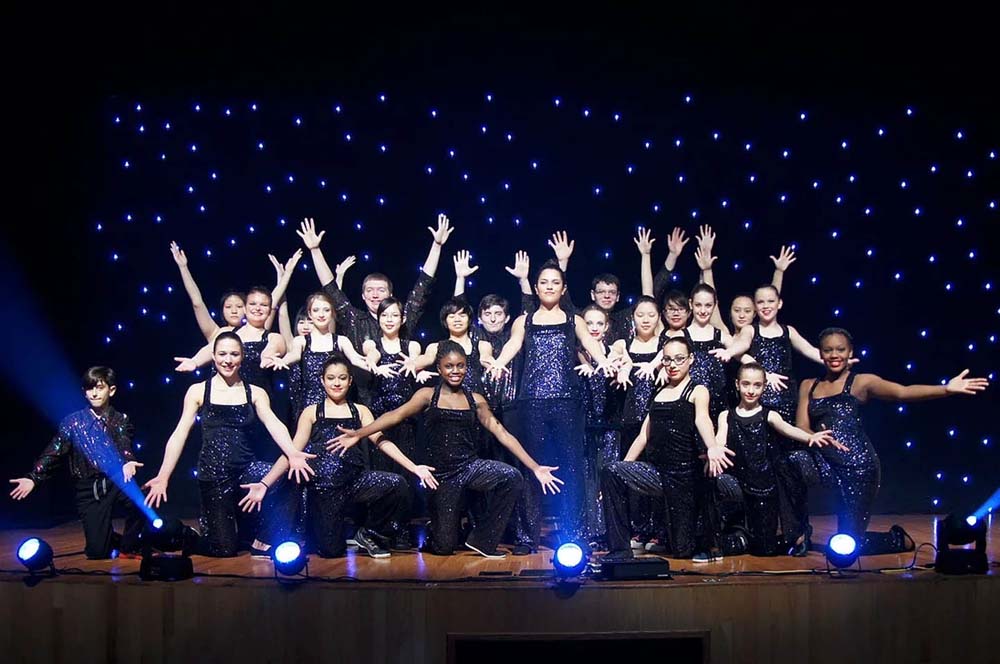
The Performing Arts program is built around a Musical Theatre training curriculum that develops students as true “triple-threat” performers in singing, dancing, and acting. From the earliest years, students are encouraged to explore their voices, movement, and imagination in a structured yet joyful environment.
The program is both rigorous and inspiring, offering students professional-level preparation while providing the community with vibrant musical and dramatic performances on a well-equipped stage.
From First Curtain Call to Full-Scale Productions
The journey begins in Preschool and Kindergarten, where students learn theatre techniques through music and movement. Weekly Musical Theatre classes culminate in two fully produced shows each year, complete with costumes, scenery, and props. Even the youngest performers experience the pride of stepping into the spotlight.
As students move into Lower School, they begin exploring the broader elements of production. They study character development and dramatic literature. They learn how to project ideas and emotions, how to analyze scripts, and how to speak effectively. Theatre becomes both a creative outlet and academic reinforcement, strengthening language skills and critical thinking.
By Upper School, the work deepens. Students participate in full-scale musicals and plays that demand dedication, teamwork, and mastery of craft. Each production reflects months of rehearsal and collaboration, building confidence that extends far beyond the stage.
Behind the Curtain: Crafting the Magic
While audiences see polished performances, much of the artistry unfolds behind the scenes. Banff’s Technical Theatre and Stagecraft program trains students in every aspect of theatre production.
From scenic design and theatrical painting to lighting, sound, costume construction, and stage management, students gain hands-on experience that is both practical and professional. Safety and proper use of theatre machinery are emphasized alongside technical training.
Every production at The Banff School is run by Technical Theatre students. They do not merely observe the process; they lead it. By graduation, these students are prepared for college-level and professional theatrical work, equipped with real-world experience and a strong technical foundation.
A Community of Performers and Leaders
For many students, theatre becomes a lifelong passion cultivated through the International Thespian Society and Junior Thespian Society chapters on campus. More than thirty percent of students in grades six through twelve are active members.
As part of the Educational Theatre Association, the Thespian Society recognizes excellence in theatre and fosters leadership within a supportive community. Students attend local and state festivals, participate in workshops taught by industry professionals, and engage in competitions that offer scholarship opportunities and the chance to advance to national events.
These experiences broaden artistic horizons while strengthening collaboration, service, and commitment to excellence.
Seeing the World Through an Artist’s Eye
Visual Arts holds equal prominence within the Fine Arts program. Students are introduced to the world around them through careful study of color, light, line, texture, and space. Through drawing, painting, printmaking, and sculpture, they develop heightened visual awareness and sensitivity.
Lower School students explore art as part of their daily curriculum and enrichment activities. In Upper School, Visual Arts becomes an academic elective where students refine techniques and expand creative voice. Museum visits encourage students to see their work within a broader historical and cultural context, reinforcing that art is both personal expression and shared human experience.
Guided by Passionate Mentors
Behind every performance and every brushstroke stands a faculty deeply committed to the arts. The Fine Arts Faculty members are dedicated educators who share their expertise with enthusiasm and purpose. Their commitment ensures that arts education remains accessible to every student.
The program continues to evolve each year, expanding opportunities to meet the talents and ambitions of Banff students.
Confidence That Lasts a Lifetime
At The Banff School, Fine Arts strengthens academic preparation while shaping character. Students develop emotional maturity, resilience, collaboration skills, and the confidence to take risks. They graduate prepared for the college or university of their choice with a strong academic foundation and the poise to succeed.
In the quiet moments after the curtain falls or the paint dries, what remains is something enduring. Students who know how to create. Students who know how to communicate. Students who know how to stand confidently in the world.
That is the true art of educating the whole child.
Comments (0)
This thread has been closed from taking new comments.